
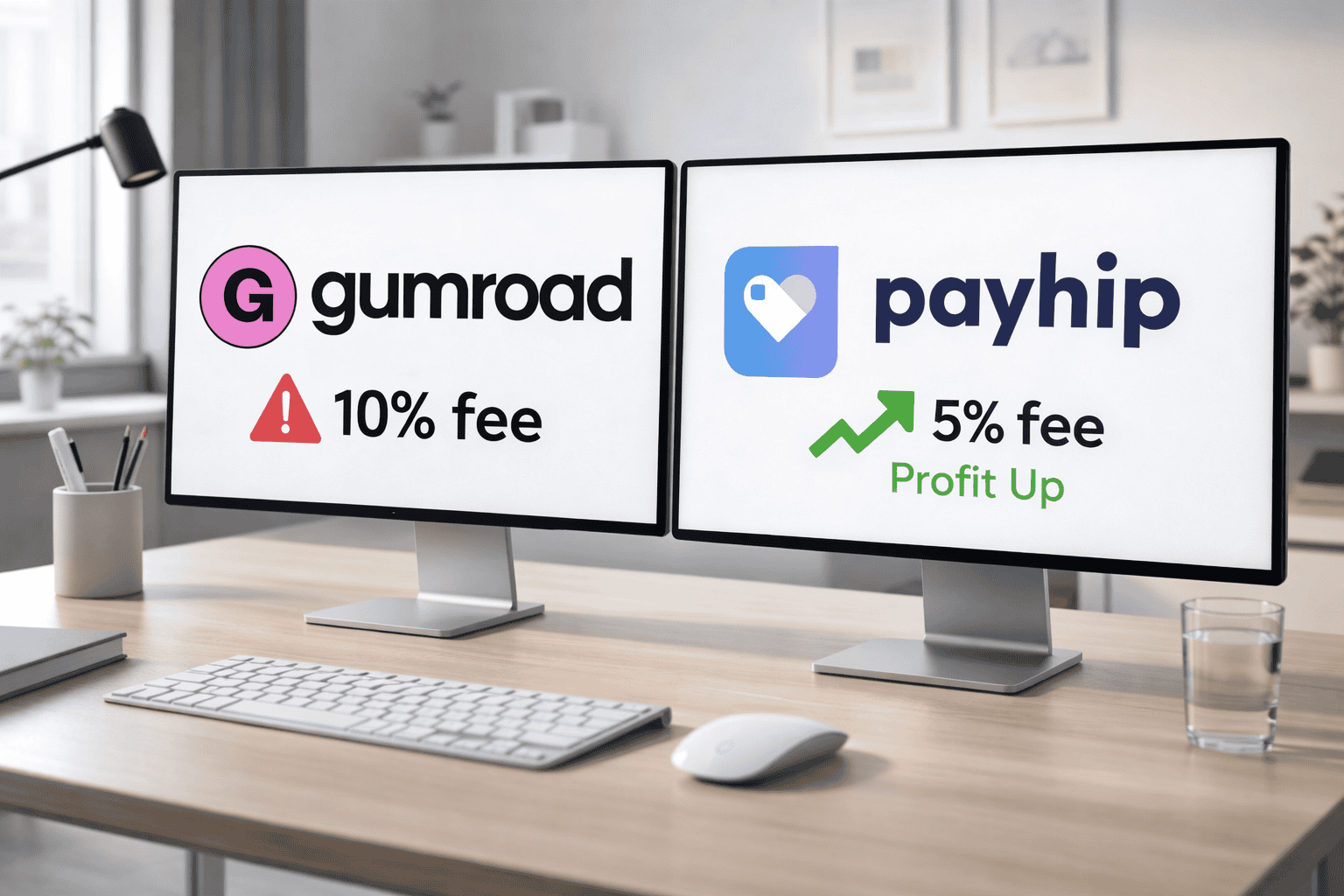
Gumroad vs Payhip 2026: Why I Switched & Saved $1,500
Gumroad vs Payhip 2026 is a comparison every digital creator should read before choosing a selling platform. I’m a software developer who sold digital products on Gumroad for two years, but by early 2026, their 10% fee started cutting deeply into my profits.
I’ve been using Gumroad for the past two years. It’s a clean interface and a great platform, but their 10% flat fee was becoming a “Success Tax” for me. As my sales increased, I began to realize I was wasting thousands of dollars just on fees.
After switching to Payhip, I saved nearly $1,500 in one year without changing my pricing or traffic. In this article, I’ll share my real-world developer experience and help you decide which platform is better for you in 2026.

The Math Behind the Move: Saving $1,500 in Fees
Now let’s do some “Developer Math”. Gumroad now charges 10% on every sale (plus payment processing fees), while Payhip’s free plan charges 5%.
If you make $2,500 in sales a month (which is normal for a decent software script or ebook), here are some calculations:
- Gumroad Fees (10%): $250 per month.
- Payhip Fees (5%): $125 per month.
- Monthly Savings: $125.
- Yearly Total Savings: $1,500!
You can invest this $1,500 in your hosting, premium developer tools, or marketing ads. Just see how much “Raise” you can get just by switching platforms.
1. Payhip’s Tech Stack: A Developer’s Perspective
As a developer, I’m not just focused on pricing; I also look at the flexibility and performance of the tool. Gumroad’s checkout process is a bit rigid, while Payhip offers a lot more control.
- Customization: Payhip’s store builder is very lightweight. You can easily change the colors and layout to suit your brand.
- Checkout Speed: Payhip’s checkout pages load fast. Low latency means fewer cart abandonments.
- API & Webhooks: If you’re selling software, Payhip’s webhooks are very solid. I integrated it with my Flutter licensing system very easily.
While evaluating Gumroad alternatives, I noticed that Payhip’s dashboard is much more intuitive for non-technical users as well. However, from a coding perspective, the ease with which you can drop a Payhip embed code into a custom site is a huge plus. This flexibility is a core reason why the Gumroad vs Payhip 2026 shift is becoming a trend among indie hackers and developers.
2. Handling the EU VAT Headache (Automatically)
When targeting a worldwide market, the biggest issue is “Tax”, especially in Europe (EU VAT). Gumroad claims to be its “Merchant of Record”, but Payhip has simplified it even further.
Payhip also automatically calculates and reports EU VAT. You no longer need to wear tax sheets for each country. With global tax rules tightening in 2026, this feature is my biggest stress reliever.

3. The Ultimate Gumroad vs Payhip 2026 Feature Comparison
|
Feature |
Gumroad |
Payhip |
|---|---|---|
|
Transaction Fee |
10% Flat |
5% (Free) / 0% (Pro) |
|
Monthly Cost |
$0 |
$0 / $29 / $99 |
|
Email Marketing |
Basic |
Advanced Automation |
|
Membership Sites |
Good |
Excellent & Easy |
|
Custom Domain |
Available |
Available (Free setup) |
4. Why “Marketplace” Isn’t Everything in 2026
Many people say that Gumroad’s ‘Discover’ marketplace drives sales. But the reality is that by 2026, 90% of your sales will come from your own marketing (social media, YouTube, email). Why give Gumroad an extra 10% when you’re already driving traffic through your own hard work?
Payhip provides all the tools (Upsells, Cross-sells, and Affiliate system) you need to manage your sales yourself. It’s important to remember in this Gumroad vs. Payhip 2026 comparison that you should be in control, not the platform.
Another deciding factor in the Payhip vs Gumroad fees debate is the payout speed. In 2026, cash flow is king. Gumroad often holds funds for up to 7 days, whereas Payhip sends money directly to your Stripe or PayPal account instantly. When you look at the best platform to sell digital products from a business owner’s view, having immediate access to your capital is much better for reinvestment.
5. The “Migration” Process: Was it Difficult?
People often don’t change platforms because they think the migration will be too difficult. The migration for Gumroad vs Payhip 2026 was surprisingly smooth and took me less than an hour. I moved my entire store in 45 minutes.
- Product Export: Download your product details from Gumroad.
- Payhip Setup: Create an account by visiting Payhip Store.
- Import & Branding: Upload products and connect your Stripe/PayPal account.
- Redirect Links: Update links on your website and social media.
Simple! Payhip’s interface is so intuitive that you won’t need a separate tutorial to learn it.
Another thing to consider in the Gumroad alternatives battle is the affiliate management system. Payhip allows you to recruit affiliates to sell your products for you, which is much easier to manage than Gumroad’s current setup. If you are serious about scaling your digital empire, the Gumroad vs Payhip 2026 choice becomes very clear once you look at these growth-oriented features.
In January 2026, I migrated my Flutter UI Kit store from Gumroad to Payhip, and my Stripe payout reports clearly showed the fee difference within the first month.
6. Digital Product Protection (Security Features)
Security is another major factor in the Gumroad vs Payhip 2026 debate, especially for those selling high-ticket software. As a software developer, piracy is my worst enemy. I really enjoyed the PDF Stamping and Software License Keys features on Payhip. Whenever someone buys my eBook, Payhip stamps the buyer’s email address and order ID on every page, significantly reducing piracy.
Is Payhip Right for You? (Final Verdict)
If you’re just starting and earning up to $500 a month, you might not notice the difference, but if you’re a professional creator looking to scale, Gumroad’s 10% fee is eating into your profits.
Switch to Payhip if:
- You want to reduce your fees by 50%.
- You need more store customizations.
- You want to sell digital products and courses in one place.
If you are interested in selling digital products without a subscription, then read this article: Sell Digital Products Without Subscription (Free 2026 Guide)

Before I finalized my migration, I spent hours researching Gumroad vs Payhip 2026 on forums like Reddit and X (Twitter). The consensus among high-volume sellers is that Gumroad’s 10% ‘Success Tax’ is no longer sustainable. If you are serious about building a long-term brand, the Best platform to sell digital products becomes very simple: go where you keep more of your hard-earned money.
Frequently Asked Questions (FAQs)
Q1: Is Payhip really free?
Yes, Payhip has a free plan with no monthly fees, just a 5% transaction fee on each sale.
Q2: Can I sell subscriptions on Payhip?
Absolutely! Payhip is best for membership sites and monthly subscriptions.
Q3: How does Payhip provide payments?
Payhip connects directly with PayPal and Stripe. As soon as someone makes a purchase, the money is immediately transferred to your account.
Q4: Which is better: Gumroad or Payhip in 2026?
Payhip is better in terms of profit and customization. Gumroad is slightly higher for marketplace visibility, but their fees are much higher.
Conclusion
Final thoughts on Gumroad vs Payhip 2026: If you want to scale, Payhip is the clear winner.
Friends, after investing a lot of money, you’ll now have to make smart decisions. For me, moving to Payhip was the best business decision of 2026. You can also try it and save your $1,500.





One Comment